Below is my July 2026 Patreon post. If you like this content, please consider signing up to my Patreon. I’m not funded by any think tanks, universities, or security services, so for as little as $2/month, you can help support antifascist research and get (usually) exclusive content! www.patreon.com/spencersunshine
We can’t always be right—but if we are lucky, being wrong can be an illuminating experience. And this is the case with how I was wrong about the origins of the name of James Mason’s book Siege.
In 2024, I published my book Neo-Nazi Terrorism and Countercultural Fascism: The Origins and Afterlife of James Mason’s Siege. It documents the origins of the ideas of James Mason, whose book Siege is the most influential work inspiring a global network of neo-Nazi terrorists. In it, he advocates a campaign of random violence, including massacres, assassinations, serial killers, and mass racial unrest.
Because, among other things, I’m an obsessive researcher, my book has 450 pages, almost thirty chapters, and thousands of references. So no matter how careful I was, I (painfully) admitted from the get-go that there were going to be errors, even though I had it factchecked (twice, in some sections). And indeed a few have been pointed out, though fortunately they are mostly minor.
However, I recently was corrected about one of the most interesting ones—although at least in this case, I had openly said it was a guess. But it was quite an important point, as it was about the origin of the name “Siege.” I had come to the conclusion—and I think for very good reasons—that the name was taken from Norman Mailer’s best-selling 1968 book Miami and the Siege of Chicago, which portrays street clashes between the SDS and the Chicago police in great detail. But in fact, the name is taken from a different book: Edwin Corley’s 1969 trashy potboiler Siege, which fantasizes about a race war initiated by black radicals who seize Manhattan in a bid to establish a black state. (Before we begin, if you’d like to read Corley’s book, you can buy it used, get the Kindle version at Amazon, or read it for free on the Internet Archive.)
The backstory of this is that I interviewed a number of people for the book who had been neo-Nazi activists in the 1970s. These included James Mason—but also Martin Kerr, who is the current leader of the New Order. (This is the third name of the group that was originally the American Nazi Party; in 1967 the name was changed to the National Socialist White Workers Party [NSWPP], and then again in 1983 to the New Order.) Kerr and I have a mutual interest in the history of postwar National Socialism in the US and have had a respectful exchange. To thank him for his help, I sent him a copy of my book when it was released.
But recently—two years after the book’s release—he wrote and told me something new: that the name Siege was not taken from Norman Mailer’s book, but rather from Edwin Corley’s.
Siege was the name of a publication of the National Socialist Liberation Front (NSLF), a NSWPP splinter group which was founded Joseph Tommasi; the first two issues were both published in 1974. The NSLF was different from prior US post-war neo-Nazi groups because it openly advocated guerrilla warfare in hopes of overthrowing the US government and establishing a National Socialist state. James Mason was openly inspired by the NSLF, and after Tommasi died, he joined the group in 1976. In 1980 Mason revived the publication as SIEGE; at first it continued as an NSLF publication, but when he left the group in 1982, it became his personal vehicle.
In my defense, I had written in my book that the Mailer title was a guess, albeit one based on information which Mason himself gave:
The name Siege came from the New Left, but its exact origin is shrouded in mystery. According to Mason, Tommasi “took the name SIEGE from an L.A. County Library book by that title which was devoted to the Weather Underground faction of the SDS,” the Students for a Democratic Society. Later, Mason wrote that it came directly from the Weather Underground, the armed struggle group that emerged from the SDS leadership.
However, there does not appear to be a book on the Weather Underground titled “Siege.” The most likely candidate for the name is Norman Mailer’s Miami and the Siege of Chicago. Long passages in the book described clashes during the 1968 Democratic convention in Chicago between police and protestors, including the SDS—but not the Weather Underground, as it had not formed yet. However, this demonstration is often confused with the Days of Rage, the inaugural event of the Weather Underground, which was also in Chicago—but the next year. (Neo-Nazi Terrorism and Countercultural Fascism, p.38)
But Kerr had better information. Unlike Mason, he knew Tommasi personally, having been his subordinate in their local NSWPP chapter. Kerr told me that Tommasi read Corley’s book during his last year in high school and that it had an “electrifying effect on him,” as it “suggested a new, violent direction to the NS[National Socialist] movement.” Kerr said that Tommasi sold remaindered copies of the book at the NSLF bookstore, and the two had discussed it.
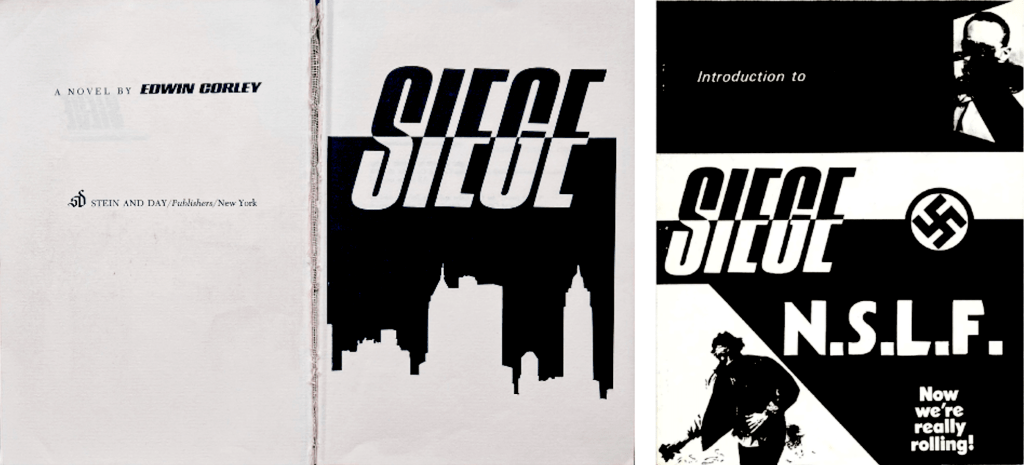
Kerr pointed out that the typeface of the title on the original Siege book matched the one used by Tommasi on the cover of the first issue of his Siege. In fact, it even matched a specific version of the typeface which appeared on the inside the hardback edition of the Corley book. (See the image at top for the two side-by-side.)
I’d never heard of Corley, who turned out a prolific run of mystery and thriller novels, starting in 1969 and running through his death in 1981 at the relatively young age of 50. According to a website run by his children, Siege was the first of 24 books he wrote under four names. (A 25th was a novelization of the 1976 movie Grizzly, written under yet another pseudonym.) Siege portrays a bizarre plot by radical black nationalists to establish a separate black state—in New Jersey, of all places. They plan to do this by taking over Manhattan and ransoming it in return for an area they can ethnically cleanse and then colonize with black people.
The story revolves around two characters. William Gray is the committed, ruthless, and unethical mastermind of the scheme. As part of a multi-year plan, he woos various high-level contacts in the military, capitalism, and the arts, after which he recruits thousands of black army veterans for his Afro-American Army of Liberation (AAAL).
The most important contact he is able to draw in is General Stanley Shawcross. A highly decorated general in Vietnam known for always carrying two grenades on his belt, Shawcross becomes embittered at the treatment of the black troops. After his family is killed by (what he is led to believe are) white supremacists, Gray recruits him to lead the AAAL. But Shawcross has been manipulated; it was Gray’s men who murdered his family in order to make him emotionally susceptible to the recruiting pitch. But Gray’s nefariousness doesn’t just end there. He has his main competitor assassinated: Malcolm X. Gray’s lack of principles and hypocrisy is emphasised by the fact that he only dates white women, even having his own girlfriend murdered when she becomes inconvenient.
The half-baked plan, devised by Shawcross, is for their makeshift army to infiltrate Manhattan, blow up the bridges to the island, and then ransom it for New Jersey, which they plan to rechristen “Redemption.” Corley says this is the “siege of Manhattan,” a “siege from within.” They do this with the backing of some African countries who positioned themselves as anti-imperialist comrades of black radical movement, united in fighting global white supremacy.
The plan works at the beginning. The AAAL seizes Manhattan (“the siege has begun”), but the plan starts to go awry when a massive fire breaks out, burning down Harlem and threatening the whole city. Gray is deposed in a coup by his more radical subordinate Raymond Carpenter, who executes the New York City mayor on live TV, leading to the African countries withdrawing support. The President, who until then had deferred to the New York governor about the situation, decides to send in a commando team to decapitate the AAAL leadership, while simultaneously announcing a massive program to increase access to food, housing, and education for black Americans.
But the team is beaten to the punch. Incensed by both the execution and other calls by Carpenter for more murder, Shawcross confronts him. But before he is killed, Carpenter enlightens Shawcross to the fact that it was Gray who put the hit on his family. Shaken, Shawcross then confronts Gray before pulling the pins on his signature grenades, killing them both. “The Siege is over.”
Along the way, they are joined by a dizzying array of other characters, who either represent famous figures of the time (for example, Reverend Abner Greenbriar is MLK, Jr.) or play underdeveloped, or even seemingly pointless, walk-on roles.
Corley published Siege in early 1969, at exactly the right time. Against the backdrop of the Vietnam War, cities burned as black anger over racism exploded, as the gains of the Civil Rights Movement stalled out and further changes were not forthcoming. Black Panthers marched in the streets brandishing guns and calling for violent revolution, while radicals less disciplined than the Panthers made even more unhinged statements about rivers of white blood. This only added to white fears of black revenge, which had long been a staple of the American imagination; in fact, William Styron’s Pulitzer Prize-winning novel The Confessions of Nat Turner, about an 1831 slave revolt—whose victims included children—had been released only two years earlier. And if anyone missed the reference, Siege began with an epigraph from the real Nat Turner.
Corley was riding the zeitgeist.
Nonetheless, it was a weird book to inspire a high school neo-Nazi. It’s filled with denunciations of racism in America, and more or less accurately shows the divisions between black radicals, their sympathizers, and more reformist elements, as they try to figure out the best way to maneuver strategically in the quickly changing context of escalating war and increasing discontent. While the goal of establishing a black racial state could easily be reinterpreted as seeking to make a white one, Tommasi himself stated that he opposed separatism as a strategy. And, last, the whole plan ends up in a miserable failure due to poor strategy and infighting, something just as likely to befall neo-Nazis as black nationalists. There was a more appropriate race war fantasy, William Pierce’s Turner Diaries, but it was still a few years away from coming out. (In any event, Tommasi and Pierce, who were both in the NSWPP together, hated each other.)
When I tracked Corley’s Siege down, I actually ended up with two separate editions. The first was the 1969 paperback on Avon Books which I got online; the copy I bought was about to split down the spine, and the bookseller returned my money (and I got to keep the book!). But this turned out to be very fortuitous.
I next ILL’ed the book from my library and got the hardcover version, also published in 1969 by Stein and Day. (It was also damaged; the library even gave me the book in a plastic vinyl bag to keep it intact.) And it was this one with the split black-and-white typeface that Tommasi had copied.
Corley is a nice stylist and he reads easily. Nonetheless, the paperback is about 350 pages and I got bored about a third of the way through. But my opinion was obviously not everyone’s. According to WorldCat, in addition to the two 1969 US editions, two separate ones came out in Britain in 1969 and 1971. Three editions of a Spanish translation—El Asedio—were published in 1969, 1970, and 1974, while a Finnish translation, Manhattanin valloitus (“Conquest of Manhattan”), appeared in 1971. (It is also possible that an English-language edition was published in Taiwan by 文藝出版社—which translates to something like “Literature and Art Publishing House”—but WorldCat is not always right.) A hardcover was reissued in 1984 in the US, and much later a Kindle version came out.
The first edition features some impressive blurbs. These include novelist Kurt Vonnegut (“fascinating!”), Rep. Adam Clayton Powell (“totally possible, totally plausible, and totally practical”), and the Chicago Sun-Times (“SIEGE is explosive—too powerful to be ignored.”). Those opinions were not universal, however. The New York Times wrote that, “There must be a machine somewhere underground, a cross between a computer and a garbage disposal, to which publishers feed headlines, surveys, clippings, stereotypes, sentimentalities, racial and/or sexual and/or death fantasies for processing and packaging. The prose product is then sold to ‘consumers,’ not readers: a form of freeze-dried fiction, rather like those slabs of rectangulated cutlet that substitute these days for food. ‘Siege’ is such a product.”
Ouch!
In addition to the Grizzly novelization, a couple of Corley’s books were made into movies. Hijacked, released in 1970 under the name David Harper, became the 1972 film Skyjacked, featuring Charlton Heston. And Corley’s 1974 novel Cold River, written under the name William Judson, was made into the film of the same name in 1982.
(Additionally, the 1969 edition of Siege says it’s “soon a major motion picture.” But I emailed the Corley website, and Edwin’s son Richard wrote me back saying “no movie was ever made from the story. Publishers back in the day often inflated supposed film interest in the hopes of selling more copies, but to my knowledge, that is as far as it went.”)
I would have never guessed the origin of the Siege name was Corley’s book: it’s a novel, and it’s not about the Weather Underground or SDS. For that matter, there isn’t even a character in there that could be interpreted as a member of those groups. It’s possible that an NSLF member later conflated the Corley and Mailer books in their mind and then passed that idea on to Mason. But maybe it was just a game of telephone, as well.
In any event, the search for the origins of the title of Mason’s Siege seems to be conclusively settled. But, to be honest, there is no particular need to read (the other) Siege.

