
This is was my contribution to an anthology I co-edited with Pam Chamberlain, Matthew N. Lyons, and Abby Scher, called Exposing the Right and Fighting for Democracy: Celebrating Chip Berlet as Journalist and Scholar (Routledge, 2022). (If the hardcopy is too expense, it is also usually available at your favorite pirate website.) This festschrift—a collection of essays in honor of a scholar, often done at the end of their career—was done for Chip after we found out he had Alzheimer’s; he lived with it for a number of years before finally dying of leukemia in 2026. If you’d like to know more about his life, Daryle Lamont Jenkins and I wrote an obituary when he passed away.
Below is my contribution to the book.
“Ruminations on an Intellectual History of Chip Berlet and the “Right-Wing Populism” Formulation”
In his four-decade long career, Chip Berlet has worked in overlapping roles of activist, scholar, journalist, and mentor. He has moved between different political movements and helped inspire his own brand of analysis of the Right. I also think of Chip as one of the very best who came out of the tradition of U.S. New Left independent intellectuals. Too many of his intellectual peers, both inside and outside the academy, have contributed to the generation gap that is so glaring today on the Left between Boomers and the generations below them. Chip is one of the few from this crowd that was able to navigate this divide, and he did it both consciously and successfully. The multigenerational contributors to this festschrift testify to this.
Chip was not just a watcher and chronicler of the Right, he also theorized about it. Here, he falls directly into this New Left intellectual pattern. After the explosion of the 1960s, for many decades there was a fascination on the Left with having “new theory,” although usually about Left ideology itself. There was a feeling of insufficiency about many of the older approaches, both in how they dealt with postwar Western society as well as how they related to issues of increasing importance like racial, sexual, and gender identity, as well as ecology. And so many writers coming out of this movement, both academics and independents (at a time when being an independent intellectual was far more feasible, thanks to now-vanished high pay rates for journalism, and widely spread progressive foundation and grant money), would go on to create their own new theories. It was not just a mood of the moment, it was also a good way to make your name.
However, unlike more recent generations, these intellectuals had a much stronger tendency to do so while part of, or at least in direct dialogue with, the movements they were writing about. (On their part, these movements had a greater appreciation of intellectual rigor and placed far more importance on the need for analysis than those of the past couple decades. This has been mirrored by a move of theoreticians into the academy who have become far more self-referential to their peers instead of being embedded in political movements.)
The objects of Chip’s analysis, like his other modes, fall within a general trajectory of looking at reactionary politics, but within that are many faceted. Like a number of people I have met from the more ideologically driven Left, my first encounter with his work was his “Right Woos Left” essay (although, after its revisions, it is basically a short book). In contradiction to the ever-present deniers on the Left, it details the numerous cases where right-wing groups made overtures to the Left, left-wing groups received them, and occasionally—most famously with Lyndon LaRouche—traversed that boundary so profoundly that they actually morphed into Far Right projects. (Chip and I have a difference in terminology; in this essay I will use the term “Far Right” when referring to things from my perspective, and “right-wing populist” when it refers to his. As I explain below, they are roughly equivalent.)
Chip encouraged my interest in this field. He solicited my analysis of a newer grouping which continued this Right woos Left trajectory, the National Anarchists, and then got Political Research Associates—the think tank he co-founded, and at that time was still working at—to publish it. (It was well received and helped propel my work in this field.) And, for better or worse, Chip also encouraged me to look more closely at contemporary antisemites and fascists. After having spent many years on the ideological nuts and bolts of the Left, I was ready for a change, so writing historical case studies of Far Right and antisemitic actors was a welcome change of pace. While today this is veritable industry, in the late ‘00s this was considered irrelevant, if not a distraction from the “real” issues or even—especially from those in movements that sought accommodation with various antisemites, paleocons, and conspiracy theorists—some kind of neoliberal ploy to undermine the Left. If you google “Chip Berlet” plus “Ford Foundation,” “controlled opposition,” or “leftist gatekeeper,” you’ll see what I mean.
Over the years, like others who first found Chip through his work on left/right crossover movements, my work evolved into looking at right-wing structures themselves. And as the U.S. Far Right rose in popularity—culminating in Trump, but whose recent trajectory should be seen in the right-wing reactions to Barack Obama’s 2008 election, including the formation of the Tea Party and revival of the Patriot movement—more people wanted me to explain what was happening in their communities. This was especially true as I started—in conjunction with the Rural Organizing Project—to track the Patriot movement paramilitaries that had formed armed encampments in the Western states, and then took over the Malheur National Wildlife Refuge in Oregon in January 2016.
I quickly found out that most people were not interested in the details of these groups, which is the bread and butter of Far Right watchers. Not just that, but most progressives tended to think about the Right as what I call the “big black box”—a single, undifferentiated stretch of political terrain with no recognizable differences between ideologies and organizations. (This is compounded by the widespread use of the term “white supremacy” in identity politics circles, as the same term means something quite different to those who analyze the Far Right.) Because of the black box, progressives generally don’t see, for example, differences between neoliberal and populist economics; multi-racial militias and white nationalists; the religious divisions between Christians, Jews, Heathens, Satanists, and atheists; and the implications of the white separatist versus supremacist divide. Since concrete counter-organizing against these groups—which, for me, is the central goal of this intellectual work—requires this specific knowledge, I needed a coherent, intelligible, and easily graspable framework to give people.
At this point I turned back to Right-Wing Populism in America, which Chip had written with Matthew Lyons and published in 2000. I had used it mostly as a reference work for the different movements it covered from the 1800s through the 1990s. Now, however, I started to look at the framework that they had laid out in the book’s introduction more closely. My work on Left ideology had ended up circling around debates over taxonomical definitions, and knowing this was a hot topic in right-wing studies, until then I had, quite consciously, avoided delving into that dialogue. When talking to others who were deeply interested in the details of these politics and familiar with ideological niches, this was not necessary. But now, doing work oriented toward the general public, it was unavoidable.
* * *
When I first read the theory, which doesn’t even take up all eighteen-pages of the introduction, I passed it over quickly. It says, essentially, this: right-wing populism is based on four different attributes. They are producerism[1]; scapegoating and demonization; conspiracism; and apocalyptic narratives and millennial visions.
There are a few other elements to the formulation as well. Frequently overlooked—including by myself, until Abby Scher called my attention to it—is the caveat at the very beginning that right-wing populism is “motivated or centrally defined by a backlash against liberation movements, social reform, or revolution.”[2] Chip and Matthew also say their formulation rejects two common approaches. The first is “centrist/extremist theory,” which posits liberal democracy as the norm and all other ideological actors as wild-eyed extremists who are police problems at best and criminal traitors at worst. Second, Chip and Matthew don’t see right-wing populists as deranged cranks. While their ideas are often outlandish, in fact they carry out their work in much the same way as any other social or political movement, and they should be looked at using the same analytical tools that others are. (The formulation also parses some right-wing populist subsets, such as the Reactionary Right, Hard Right, and Far Right. But to be honest I always skipped over this part of the analysis. The important essence of these are the recognition that right-wing populists fall on different parts of the “reform or revolution” spectrum.)
One reason I didn’t initially spend much time on this formulation was that academics create an endless number of taxonomies covering numerous fields, movements, and genres. (More than one has made a career from merely cataloging a field’s various taxonomies.) If you’re not an expert on the details, and sometimes if you are, one definition can seem to be no more insightful—or accurate—than another. Besides, Chip’s definition seemed to lack some theoretical depth: What was the analysis itself based on? It certainly wasn’t a Marxist analysis, even though Chip occasionally uses the term to refer to himself.[3] (Chip would also variously refer to himself as a defender of democracy and free speech, a Christian, and/or a Zippie, depending on his mood and audience.) It was a kind of ideal type. There was also something structuralist about its claims of how old this form was; this was unnerving for someone of my generation, for whom post-structuralist reflexes invariably remain about certain topics. What were this movement’s predecessors? And was this definition applicable in other Western countries, much less other parts of the world?
Whereas I had initially used the formulation simply because it was the closest thing on the shelf to grab, over the years I have come to appreciate how, despite its seeming simplicity, it is actually a robust and multifaceted approach. Six attributes stand out in particular.
One of the interesting aspects of the formulation is that it is only partly an Ideal Type; it is also a syncretic theory. Its influences include: Moishe Postone’s critique of abstraction and antisemitism, as well as pieces of the Frankfurt School; Alexander Saxton’s idea of producerism; how both William Domhoff and Sarah Diamond look at power structures; Jean Hardisty’s emphasis on “mobilizing resentment,” Roger Griffin’s fascism as “palingenetic ultranationalism”; Richard Hofstadter’s take on conspiracy theories; Ervin Goffman’s frame analysis; and Margaret Canovan’s populism framework—to name just some of the more obvious ones. I think this syncretism allowed people coming from many different theoretical traditions to easily see their existing viewpoints reflected in the framework.
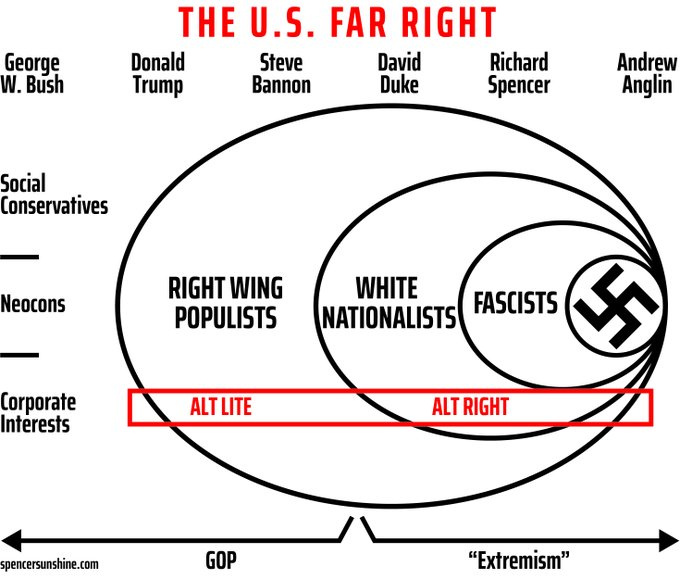
Second—and, to be fair, this is perhaps an unfair standard to hold theoretical frameworks to—was its sheer usefulness. I have borrowed it as the framing mechanism for my own talks about the Far Right for popular audiences. Using it, in the space of about ten minutes I can disassemble the “big black box” in listeners’ minds—cleanly cleaving off what Chip calls “right-wing populism” from regular conservatism, giving people a sense of how it appeals to the conservative base, and then laying out a map of its parliamentary mainstreamers and armed revolutionaries.
Third, and perhaps most importantly, it was based on decades of deep research into the details of actual political movements. Too much “theory” is a commentary on a commentary on a commentary that was based, to a greater (and sometimes significantly lesser) extent, on real-world actors. University libraries are filled with innumerable manuscripts of this type, of little use or interest to anyone was has not been given the key to their secret garden. As I looked at different Far Right groups, I could usually see Chip’s formulation reflected quite clearly, and in many cases it drew my attention to parts of what they were doing that I had overlooked. From my perspective, the framework was based on his close studies of the John Birch Society, the LaRouchites, the militia movement, and conspiracy theorists—especially antisemites.
Fourth, it was intrinsically a left-leaning theory. Despite Chip’s liberal side and his robust defense of democracy in his political conclusions, his analysis is more of the Left. Here, his claims to be a “marxist” make more sense, if by that one is referring to a critique of inequities in society with a specific analysis of which groups are subjugated and how that develops historically, plus a view of the oppressed as potential “revolutionary subjects” who have the capacity, perhaps in conjunction with “enlightened” sectors of the non-oppressed, to create a more just and equal society. Right-Wing Populism in America also shows the influence of Lyons, who comes from a more Marxist background than Chip and edits the blog Three Way Fight. His work reflects an analysis, popular in the 1970s and preceding a host of later formulations, in which a class analysis is inflected with other categories, such as race, gender, and religious/ethnic divisions. This was prominent in the Sojourner Truth Organization and also includes the Chicago school of post-Maoists around the 8th Route Readers Club periodical, the best-known of whom is J. Sakai. (Matthew told me that Thomas Ferguson’s work on “business conflict analysis” has also influenced his critique.)
Origins aside, while Chip and Matthew’s formulation could certainly be used as a seemingly “neutral” political and sociological analysis, it inherently skewed Left. It is not a materialist approach—marxism has not proven to be a very good perspective to analyze the Far Right, which has too many psychological elements to it. (It is not coincidental that the most adroit marxist commentators, such as Theodor Adorno and Wilhelm Reich, tend also to be the most heterodox of the bunch.) The book’s analysis is compatible with both radical leftists who oppose capitalism and Democrats who support it. I am sure there are even a few Republican readers who appreciate him: Chip is one of the few people who can be said to have influenced both the antifascist movement and the U.S. Justice Department. This is because he has a systemic analysis of how “right-wing populists” function to intensify existing oppression on the grounds of racial, religious, sexual, and gender differences. (A class perspective usually hovers around in the back. This allows the formulation both to be added to a strong class analysis, or to function substantively without it—although the more extreme free marketers are still targeted.)
Here, one of the more interesting of Chip’s influences comes to play. Although his original, more radical Left influences in the 1970s seemed not to reflect this background too centrally, in the 1980s and ‘90s he became profoundly influenced by “coalition politics” and its academic corollary “race/class/sex/gender” (although Chip was sure to give a centrality to antisemitism, an important part of right-wing populism). This is the direct precursor to what today is referred to as “intersectionality.”
Coalition politics were an attempt to overcome the fragmentation that 1970s identity politics had produced by creating separate feminist, LGBTQ+, black liberation, and other movements. Instead, this political approach sought to link together a number of these strains. Although this was just a moment in the Left like many others, these issues in play all represented core categories that any analysis of oppression and inequality, at least in the United States, would ultimately circle back to.
Boosted by the opposition from feminists and LGBTQ+ people to the Christian Right, Chip harnessed his critique of the Right and emphasized how they attacked each of these identities. This gave activists from these movements a clear, ideologically consistent imperative to engage in counter-organizing against right-wing populists.
This has also given Chip’s work a resonance that is not bound up tightly to its particular moment. We can see this especially with the Alt Right, which emerged at the end of Chip’s career. His broad conception of right-wing populism showed how outright neo-Nazis and Klansmen, who generally eschewed the Republicans, could get on board with Trump. It neatly mapped how the Alt Lite (the moderate wing that included gay men and Jews, and was part of the Trumpist camp) and openly antisemitic and white nationalist Alt Right proper were working in tandem. The schema’s anti-reductionist approach also captured how the Alt Right’s core values were based on what I identify as its “three pillars”—white nationalism, misogyny, and antisemitism (in addition to hosting other toxins like xenophobia, transphobia, Islamophobia, and anti-antifa/anti-Communist politics).
Fifth, Abby Scher has drawn attention to a loose school he has inspired that she called “the Berletian scholars of the Right.[4] (Ironically, she uses a different term in the festschrift, “the Berlet school,” while Shane Burley declares himself a “Chipite.”) Under whichever name, my extremely minor contribution to this school’s theory is an elucidation of the meaning of Chip and Matthew’s four-pronged conception of right-wing populism.
I’m particularly interested in how political movements use ideas. I diverge some from Chip here, and have used the sectology with which some Leftists (especially Leninists) look at their own movement, and applied it to the Far Right. This is useful because this movement also tended to form discrete organizations based around ideological positions.
What Chip shows—but doesn’t quite say—is that these four features, especially when deployed together, are a psychological mechanism that plays on the emotions of the listener to inspire them to take political action. Consciously or not, these actions will reinforce existing power structures in a society. However, these features are not an actual argument—although sometimes, as with elaborate conspiracy theories and Holocaust Denial, parts of them do take on the external trappings of one. (When you look at the details of these arguments, you will see they lack the consistency of a legitimate social theory; inevitably they make logical jumps and wildly cherry-pick evidence. It’s all facade.) When used together, I liken the four features of right-wing populism to the organ tune “Charge” that’s played at baseball games—it only has a few notes, but it is able to ramp up the emotions of the fan base.
Additionally, also implied but not quite spelled out, is that right-wing populism, at least today, is not properly part of the liberal philosophical tradition—even if it does have deep roots in what might be called “real existing liberal democracy.” This is what sets it off from other conservatives, and reinforces the argument that fascism, at least on this level, is part of right-wing populism. And, of course, it doesn’t just stop with liberals, but is a twin reaction that also targets the Left. This is what helped create the historic “antifascist consensus”—from World War Two (or at least 1941) to the present—of liberals and Leftists against a common enemy. And part of this approach is because this enemy possesses politics which, as was shown so tellingly in both Italy and Germany, has the potential to beat both of them if they are not united in opposition.
Sixth, the formulation does an interesting sidestep to avoid the long-running dispute between the scholars of right-wing populism and those in Fascism Studies. For the former, fascism is a mere subset of their unit of analysis, and usually of no special interest, especially in the present day. For the latter, fascism is a unique movement of world-historical importance, while right-wing populism, if it’s given any attention, is merely a watered down version of the real thing.
Formally, Chip and Matthew’s formulation is part of the right-wing populist school. But—and perhaps this is a side-effect of it being so broad as to cover tendencies as disparate as antisemitic populists and Christian Zionist theocratic neoliberals, blue-blood paleocons and wild-eyed extreme libertarians—it doesn’t dismiss the specific trajectories or qualities of any of these subsets. As someone with a particular interest in postwar fascism, this has been of special interest to me. I can find my work in his framework, as can those who study Islamophobia, the Christian Right, extreme free marketers, the Patriot movement and militias, and homophobic and anti-trans activists. Being a lumper and not a splitter, it is sort of undeniable that the elements that Chip pulls out to make his list are a common denominator to all the different factions lumped under the right-wing populism umbrella. It is inclusive without turning diverse elements into an undifferentiated intellectual mush. And, interestingly, his analysis reflects his own brand of progressive politics: a broad tent that includes everyone from the radical Left to mainstream liberals, without erasing their differences.
* * *
I have a few other observations to make in closing. For me, one of the interesting things about doing work on the Far Right is how many different directions it leads in. Although obviously linked, counter-organizing and antifascism is also a separate field of study. There was the Far Right’s use of the internet; relationship to the mainstream; organizing forms which ranged from lone wolf terrorists to mainstream candidates; relationship to Christianity and other religions; cross-recruitment from the Left; how nationalism and racial identities are constructed and function more generally; the role of conservative think tanks in feeding this movement; how state repression works regarding both the Left and Right; millenarian religious-political movements; and struggles over public lands, federal power, and the Constitution—all in addition to the obvious issues of white supremacy and the legacy of colonialism, misogyny and homophobia, ecological destruction, antisemitism, Islamophobia, and capitalism. And it seemed that every time I turned my attention to a new angle, Chip had already written about it and explored its nuances, often decades before.
Chip was fortunate—both for himself and us—that he was one of the early figures to try and theorize the Far Right as a whole. Although you would not guess this now—with the profusion of publications about the Far Right in the age of Trump, Farage, Bolsonaro, and Modi—that was not a topic of much scholarly interest, at least until the rise of these kinds of parties in Europe. (Indeed, even today many important U.S. groups lack studies of them or only have a single one.) Most documentation and conceptualization of these movements came from those in the right-wing monitoring business who were outside the academy.[5] Chip was, of course, one of them, but he consciously drew on the existing academic literature to co-create the formulation; his work’s syncretic nature owes something to a combination of his academic readings and his autodidacticism.
And, unlike many academics, Chip was immersed in the nuts and bolts of this movement. (One of his formative experiences regarding the Far Right included a number of years, starting in 1977,as a counter-organizer working in Chicago’s Marquette Park. Here, the National Socialist Party of America—the same neo-Nazis satirized in the Blues Brothers movie—had gained a significant foothold in this Eastern European immigrant neighborhood which was resisting desegregation.) On theoretical matters, the first person in the door who gains traction often forces everyone else to “go through” their theory, whether that’s to expand, reject, or critique it. Chip’s position, from having done extensive work on a subject that academics were largely ignoring, allowed him and Matthew to lay out a formulation without a large amount of competition. And coming back to the question of New Left intellectuals, this also played into their imperative to “make new theory.”
Last, Chip had a keen relationship to his own position in space and time. Here, in particular, he set himself off from his generational peers and the Left’s yawning generation gap. The first part of this regards his entry into the “make-your-own-theory” competition. Generally, New Left intellectuals who did went on to defend their definition against all comers; after all, this was a most-coveted intellectual possession, and redeemable for all kinds of rewards. And it was the little hill they could be king of.
Unlike so many intellectuals, Chip generally did not seek to die on this hill. He actively sought out criticism—although, to be fair, sometimes he regretted this when it came—and would often incorporate it into his own future works. Sometimes, in an almost Taoist fashion, he would even turn his critics into collaborators, as was the case with Matthew Lyons. I found the right-wing populism formulation useful; one could readily stretch it, throw it against the wall, and bounce things off of it. Not just was it sturdy and flexible, but Chip didn’t mind it being abused in this way either. I also picked it up and put it down, as the case may be, sometimes switching analysis altogether—especially when looking at fascist currents by themselves. For me it’s a tool, not a worldview, and he has always seemed okay with that.
He pushed me for many years to define my own terms about the “radical right,” “Far Right,” and the such—something I, to be honest, found annoying due to my aversion to political taxonomy, even while recognizing it was a necessary evil to use with popular audiences. I finally settled on an altered version of the formulation (replacing “right-wing populism” with “Far Right,” but excluding certain well-defined ideological streams from it, such as the Christian Right and ultra-libertarians—at least so long as they avoided tripwires like demonizing minorities in a conspiratorial key). When I told Chip this, he ceased to bother me about it, and we even co-wrote an article in which we agreed to use terms that neither of us especially liked, for the sake of internal coherence.[6] I appreciated that he implicitly saw his conception not as a final word on the subject, but as something that had both predecessors and successors.
Chip was quite conscious of his intellectual limitations, and co-wrote many of his works with others—an ability I admire, even if I can’t usually bring myself to do it. (Of course, this also allowed him to help out young scholars who needed publications, and at the same time build alliances in the sometimes dog-eat-dog world of right-wing monitoring.) He has always enjoyed meeting new people with different views, looking at what they are doing, and seeing how their projects could be integrated. Unlike his New Left peers, this was not limited to his generational cohorts. Too often these intellectuals only saw younger people—to the extent they saw them at all—as aspiring epigones and sycophants; their role was that of an empty vessel to be filled with the master’s (and, on rare occasions, mistress’s) formulations, after which they were expected to go off and proselytize them. Chip, however, sees himself as part of a stream of ideas.
Lest this festschrift devolve into hagiography, Chip was also—as he himself would regularly point out—a straight, white, cis-gendered man of a certain age. And just as we are all products of our times, he was not immune to the typical faults of those identities. Among the small world of the Left he was a star, with all that entails; on certain issues, he would be aggressive about getting his way; and he had a degree of infamy for the furious pitched battles he would periodically engage in. But at the end of the day, that just made him a regular human. The fact that to this day, he is surrounded and admired by so many people—and so many different kinds of people—is a testament to a final calculus of his actions.
A number of years ago, I helped out at a memorial service in New York City for Leonard Weinglass, the iconic leftist lawyer who defended the Chicago 7. It was a reunion of sorts, as these affairs can be, and this was one for a very particular kind of New Leftist. I vividly remember one speaker pronouncing, with a quiver in their voice, “There will never be another lawyer like Lenny Wineglass!” My first thought was, “Boy, are we in trouble then.” And my second thought was, “How typically New Left to think they were the pinnacle of political achievement.”
Although hopefully he has many more years to go, I am sure that Chip would not like this to be said about him. I think he would much rather have speakers ask that those younger people present should aspire to be like him. Even, I might dare add, they may wish to surpass him, say, by finding the lever that allows us to definitively smash fascism and white supremacy. This, I think, would bring a smile to Chip’s face—especially if he had a small part in inspiring it.
ENDNOTES
[1] The valorization of those who engage in manual labor, with a corresponding vilification of “elites” whose professions involve manipulating abstractions, as well as “parasites” who lack work. A typical producerist narrative counterposes factory workers and farmers against bankers and welfare recipients.
[2] Chip Berlet and Matthew N. Lyons, Right-Wing Populism in America (New York: Guilford Press, 2000), 5. This idea is also revisited a few pages later (10-11) as part of “countersubversive scapegoating.”
[3] One of the most humorous attacks on Chip is that he is an unreconstructed Marxist-Leninist. Like all the best conspiracy theories, there is a kernel of truth to the accusation. Chip has described his involvement as such:
“In Chicago in the 1980s I was asked by friends of my spouse to be parliamentarian at a founding meeting of a national US/Albanian Friendship Society. At the time, I was still collecting hours of such work needed to become a certified parliamentarian. I turned out to be one of the few attendees not in one of three competing Stalinist cadre organizations. Everyone was on their good behavior, however, and over several days we actually managed to draft principles of unity and a constitution and by-laws. I had quipped that if this group somehow managed to come up with democratic guidelines that didn’t require supporting the government of Albania or its political system, that even I would join. They did, so I paid my dues and have been red-baited ever since.”
However, even a quick look at Chip’s work reveals nary a sign of Hoxhaist dogma, much less any form of either Orthodox Marxism or Third World Marxism. See Chip Berlet, “Abstaining from Bad Sects: Understanding Sects, Cadres, and Mass Movement Organizations,” Resist Newsletter, vol. 8, no. 10 (December 1999), https://web.archive.org/web/20080723161421/http://resistinc.org/newsletter/issues/1999/12/berlet.html
[4] Scher said this during an introduction to a March 12, 2020 talk by Chip Berlet and Talia Lavin at the YIVO Institute for Jewish Researchin New York City. “Why the Far Right Kills,” YouTube, uploaded April 21, 2020, http://www.youtube.com/watch?v=WLN_-oc7qQ4; see at 8:47.
[5] This includes many contributors to this festschrift, including Ken Stern, Mark Potok, Pam Chamberlain, Mark Pitcavage, Fredrick Clarkson, and Heidi Beirich.
[6] Chip Berlet and Spencer Sunshine, “Rural Rage: The Roots of Right-Wing Populism in the U.S.,” Journal of Peasant Studies, vol. 46, no. 3 (May 7, 2019), 480-513; https://spencersunshine.com/2019/05/21/rural-rage

